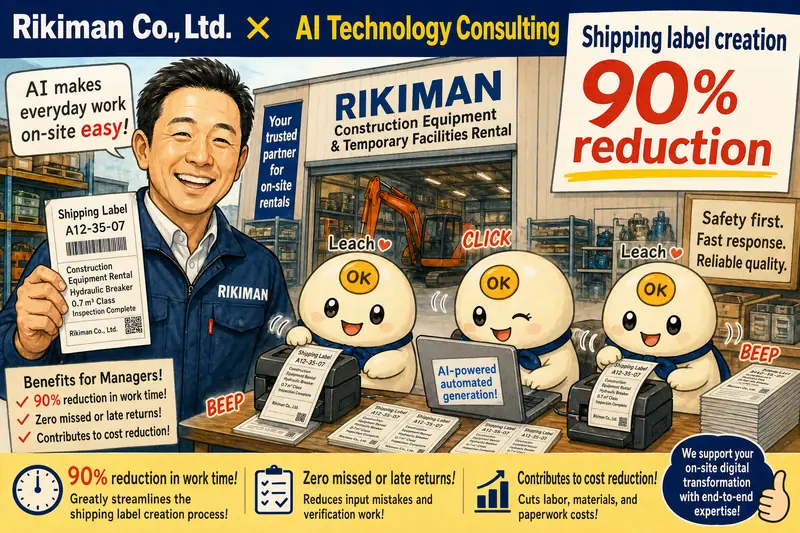
Rikiman Co., Ltd., which commands approximately 90% of the clamping hardware market share in Tokyo's large-scale construction, adopted the "Leach Generative AI Advisor" service in July 2025. In approximately 8 months, they have achieved results including a 90% reduction in shipping label creation workload. We spoke with Mr. Takeshi Isoda, Tokyo Branch Manager, and Mr. Motoki Nishikawa of the Solutions Office about their journey from adoption to results and future outlook.
Results Summary (~8 months)
◆ Achieved
◆ In Progress
Learn more about the service featured in this case study: Leach Generative AI Advisor
Company Profile
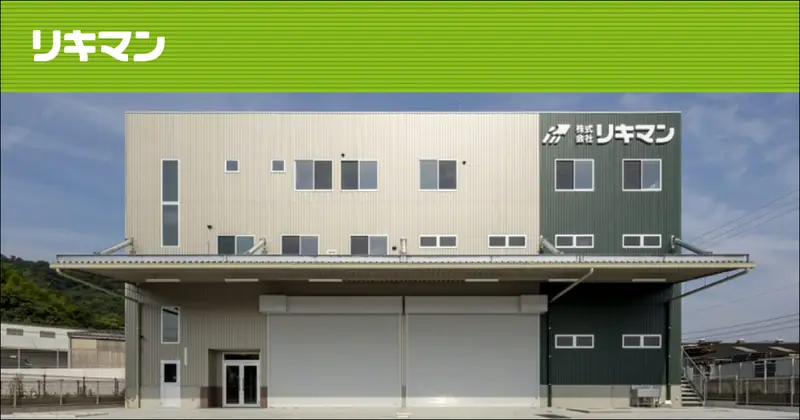
| Company | Rikiman Co., Ltd. |
| Location | Ueki 1150-5, Sue-machi, Kasuya-gun, Fukuoka |
| Founded | January 7, 1977 |
| CEO | Hajime Otsuji |
| Business | Development, manufacturing, and sales of construction clamping hardware "Rikiman Hardware"; leasing, rental, and sales of heavy temporary construction materials and environmental products |
| Employees | 70 |
| Offices | 5 locations: Tokyo, Osaka, Fukuoka, Niigata, Shikoku |
| Web | https://rikiman.com |
Interviewees:
- Mr. Takeshi Isoda — Tokyo Branch Manager. Also heads Sales, Development, and the Solutions Office (IT department).
- Mr. Motoki Nishikawa — IT Engineer in the Solutions Office. Handles both management and field operations.
1. What is Rikiman Hardware? — The "Invisible Infrastructure" Behind Roppongi Hills
Tominaga: Could you tell us about Rikiman's business?
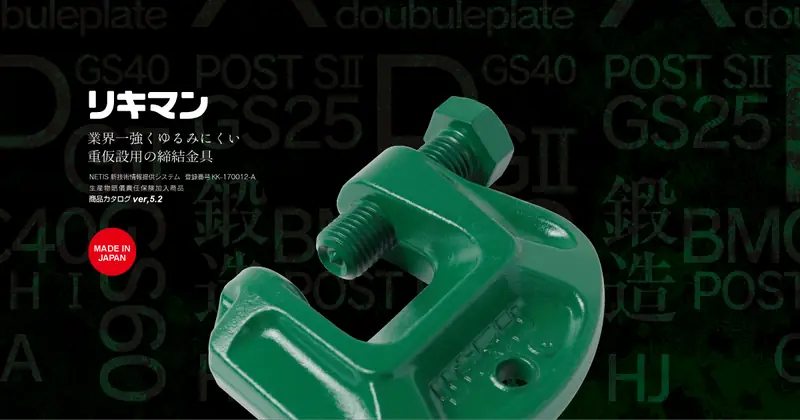
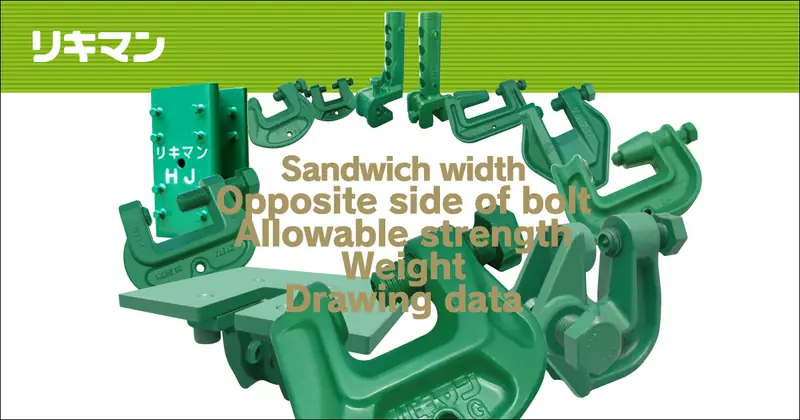
Mr. Isoda: We develop, manufacture, and sell construction clamping hardware called "Rikiman Hardware." These are used when installing work platforms — temporary structures at construction sites for placing large machinery and materials.
Tominaga: How does it compare to welding or bolt fastening?
Mr. Isoda: Installation and dismantling speed is 50-70% faster compared to welding or bolt fastening. The larger the site, the greater the benefit. Rikiman Hardware has been used at landmark construction sites including Roppongi Hills, Azabudai Hills, and Tokyo Midtown.
Tominaga: What's your market share in Tokyo?
Mr. Isoda: For clamping hardware in large-scale building construction, we hold approximately 90% share in Tokyo.
2. Challenges Before Adoption — When Manual Processes Hit Their Limits
The Spark for AI Interest
Tominaga: What sparked your interest in generative AI?
Mr. Nishikawa: It started with books I discovered through YouTube reviews. We'd always relied heavily on manual effort, but the idea that "the more people thinking about the company's future, the better the company becomes" resonated with me. Tasks that don't require human judgment should be handled by AI, so people can focus on higher-value work.
When I looked back at my first ChatGPT history, it said "reducing administrative burden." Operational efficiency was the goal from day one.
Three Key Challenges Before Adoption
Tominaga: What were the main challenges before adoption?
Mr. Nishikawa: Three main areas.
1. Handwritten inspection reports
The Tokyo office alone generates 10 inspection reports per day. Osaka had independently digitized with Excel, but all other offices were entirely handwritten. Including photo selection and attachment, it was significant workload.
2. Difficulty assessing IT procurement costs
Mr. Isoda: We simply didn't have a benchmark to judge whether quotes were fair. We had no choice but to accept whatever price our IT equipment vendor presented.
Mr. Nishikawa: I sensed the prices could be lower, but without a point of comparison, it's hard to negotiate.
3. Communication challenges in core system customization
Mr. Nishikawa: We work with a vendor to customize our lease inventory management system. Aligning on business requirements sometimes took longer than expected, and building a smoother communication process had been an ongoing challenge.
The Hurdles of AI Adoption for SMEs
Mr. Nishikawa: From seminars I've attended, AI adoption requires leadership buy-in and a culture that encourages experimentation. One setback can easily be labeled "it just cost money," and many companies lack evaluation frameworks for AI initiatives. That's why building small wins is so important.
Mr. Isoda: "Too early for us" is something you hear in every industry. But you can't make a judgment without trying first. We decided to take that first step.
3. Why They Chose Leach
How We Met
Mr. Isoda: It was at a college of technology alumni reunion. That's where we met Tominaga.
Mr. Nishikawa: It's truly a deep connection (laughs). People at the company ask "aren't you relatives?"
Internal Resistance at Launch
Tominaga: How was the initial response when you rolled it out internally?
Mr. Nishikawa: I was on board from the start. But for many colleagues, the gap in AI familiarity meant there was real hesitation.
As AI-driven improvements became visible, that resistance faded. If we'd started today, pushback would have been much lighter. Looking back, we were a bit ahead of the curve.
Mr. Isoda: Half the executives were very interested. The other half were somewhat cool about it.
Assessment of Pricing
Tominaga: How did the CEO react to the advisory fee?
Mr. Isoda: I explained it to the CEO expecting he'd think it was expensive. His first reaction was indeed "isn't that expensive?" But I persuaded him by saying "Having someone who understands IT as a supporter for the company — isn't that actually cheap?" That convinced him.
4. Changes After Adoption — Results in Numbers
Shipping Label Automation → 90% Workload Reduction
Mr. Nishikawa: The most visible result is shipping labels. We cut the workload by 90%.
When sending products to construction sites, there's a rule that labels with the general contractor's name and site name must always be attached.
Before
Core system output → Manual Excel entry → Print on paper → Cut with scissors → Tape to products
After
Core system CSV → Paste into Google Spreadsheet → GAS auto-extracts info → Auto-transfer to label software → Print and apply
Mr. Nishikawa: Tominaga suggested "why not just use GAS?" and that's what spawned this pipeline. Even employees who joined just a month ago can now produce labels efficiently. This has already been rolled out to all offices.
Inspection Report Digitization → 50-60% Reduction (Target)
Mr. Nishikawa: Next, we're working on digitizing inspection reports. When I consulted Tominaga, he suggested "how about using Google Forms?" — that was a game-changer.
If I'd been on my own, I would have made it much more complicated. But with Forms:
- Button-based so anyone can easily input data
- Photo attachment capability is powerful (photos in Excel are painful)
- Take inspection photos on-site, upload directly, and photos are linked to reports
We're building a connected flow: Google Form → Spreadsheet → Google Docs → Docx output. We're targeting 50-60% workload reduction.
IT Procurement Cost Optimization — Value as a "Gatekeeper"
Mr. Nishikawa: When I shared a PC purchase quote with Tominaga, he identified that a better option was available at a lower price point. He advised that "the newer model is build-to-order, so it should be available." After renegotiating with the vendor, we saved approximately ¥100,000.
Having an IT-savvy advisor gives you the confidence to negotiate. That's truly invaluable.
Mr. Isoda: That's the value of a "gatekeeper." Without internal IT expertise, it's difficult to assess whether a quote is fair. Going forward, we consult Tominaga whenever a quote comes in.
Improving the Core System Development Process
Mr. Nishikawa: Tominaga joined our regular meetings about the core system customization and suggested improvements to the project management approach.
- Clarify role division for meeting minutes and prep materials between client and vendor
- Set milestone-based schedules with contractual accountability
We had limited experience managing IT projects, so learning the "playbook" for project governance was a big step forward. Communication with the vendor has improved significantly since then.
Improved Quality of Internal Documents
Mr. Isoda: With generative AI adoption, the quality of internal documents and text has definitely reached a higher level for those who use it.
Mr. Nishikawa: Minutes are captured with Notta, formatted with ChatGPT, and action items generated instantly. The PDCA cycle has clearly accelerated.
Facing a similar challenge? — We'd love to help with AI adoption for manufacturers and SMEs. Book a free 30-minute consultation
5. AI Adoption Across the Company — From "Full of Resistance" to "Everyone Has a Secretary"
Shift in AI Rejection
Tominaga: Has employee awareness of AI changed?
Mr. Nishikawa: A year ago, there were concerns like "can we really trust AI with this?" Now, the perception has shifted to "it's like having a skilled secretary."
The turning points were:
- Shipping label automation: Once integrated into daily workflow, it became indispensable
- DocWorks adoption: Benefits became tangible in document creation
- Change in administrative staff: A colleague who was initially hesitant started creating documents with ChatGPT, even using terms like "traceability" in conversation
The number of people proactively using AI for internal improvement is growing steadily.
Mr. Isoda: Early on, Tominaga said "AI is like everyone having their own personal secretary," and that's gradually becoming reality. Employees are realizing this through the actual experience of work becoming easier. I don't think many other companies our size have caught on yet. We need to keep up with this industrial revolution.
The Prompt Barrier
Mr. Nishikawa: For colleagues who struggle with AI, the main barrier is prompt construction. They know what they want, but translating that into clear instructions is the hard part.
Mr. Isoda: I think 90% of people are like that. It's the same as asking someone to "make" an Excel sheet — there will need to be a department that creates prompts for people. It's just that Excel has been replaced by prompts.
6. The Value of Slack Support — How "Being Able to Ask Instantly" Changed Everything
Tominaga: How much do you use the Slack consultation channel?
Mr. Nishikawa: I consult as needed. The inspection report system — if I'd been on my own, I would have just gotten stuck and given up. The Google Forms suggestion only came about because I consulted on Slack.
Even now with the inspection report form development, I've been saying "let me bombard you with questions on Slack again." I can see where I'll get stuck, so having someone to consult with is reassuring.
Tominaga: What about being able to consult on all IT matters, not just AI?
Mr. Nishikawa: That's the biggest thing. There was a bias that "paper is better", but having someone to consult with made the transition to digital much smoother. Google Workspace adoption, vendor negotiation skills, meeting management — it's become an "ask anything about IT" help desk.
7. Future Outlook
Achieving a 4-Day Work Week
Mr. Isoda: The ultimate goal of AI adoption is to achieve a 4-day work week within the company. As we adopt AI and improve operational efficiency, I can now see it becoming achievable.
If we announce a 4-day work week, talented people will come to us. It becomes a trump card for talent acquisition. Same salary with 3 days off — the hourly rate goes up. Plus, it opens doors for people who can only work half-days.
Deeper System-Level Partnership
Mr. Isoda: Going forward, we want to deepen our partnership with Leach in the business systems domain as well. Beyond AI, we see Leach as someone we can turn to for systems questions in general.
8. Message to Fellow Manufacturers and SMEs
Service Used
- Service: Leach Generative AI Advisor
- Started: July 23, 2025 (approximately 8 months at time of interview)
For more details about the Generative AI Advisor service, please visit our service page.
Book a free consultation — Ready to explore AI for your business? Book yours here
This article is based on interviews conducted on March 25 (Session 1) and March 27, 2026 (Session 2).