![[Case Study] A 199-employee manufacturer with no IT dept gains judgment criteria for software outsourcing — Nabel Co., Ltd. × Leach Generative AI Advisor](/images/news-manga/nabel-en.webp)
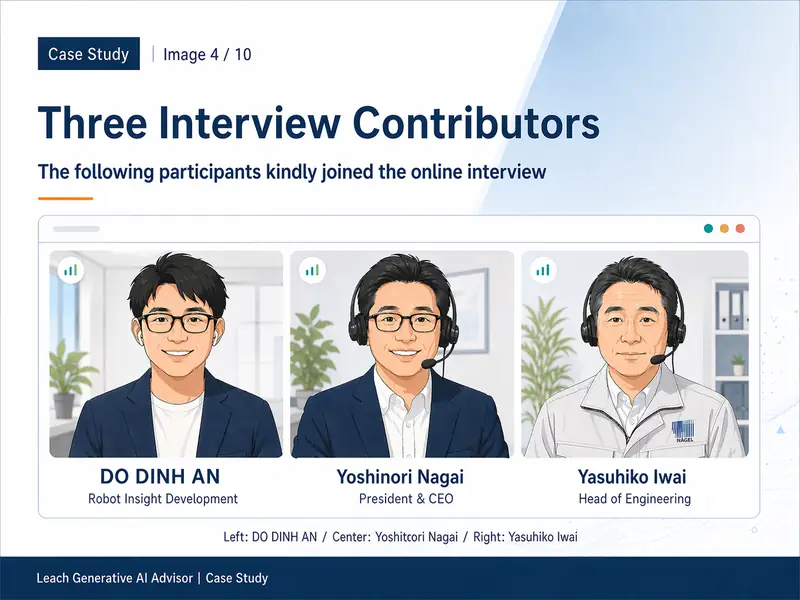
Founded in 1972 with 199 employees, Nabel Co., Ltd. — a long-established bellows manufacturer based in Iga, Mie Prefecture — brought in Leach's Generative AI Advisor in October 2025, as the company expanded its focus from hardware into software-intensive new businesses such as Robot Insight (industrial robot condition monitoring). Six months in, Nabel proposed to increase the monthly advisory fee before the annual contract renewal. What makes an advisory service earn that kind of proposal from the client side? We spoke with President & CEO Yoshitomo Nagai, Head of Engineering Yasuhiko Iwai, and Robot Insight developer DO DINH AN.
"We were signing off on software quotes without being able to judge whether they were reasonable.
Without the advisor, I'm not sure the project would have even been realized."── Yoshitomo Nagai, President & CEO, Nabel Co., Ltd.
![[Case Study] A 199-employee manufacturer with no IT dept gains judgment criteria for software outsourcing — Nabel Co., Ltd. × Leach Generative AI Advisor](/images/news/nabel-case-study-2026/slide-01-hero-en.webp)
*Quote figures referenced in this article are approximate values from comparison cases Nabel actually experienced. Some vendor names have been omitted for confidentiality.
Engagement Summary
For details on the service featured in this case, see Leach Generative AI Advisor.
Company Profile

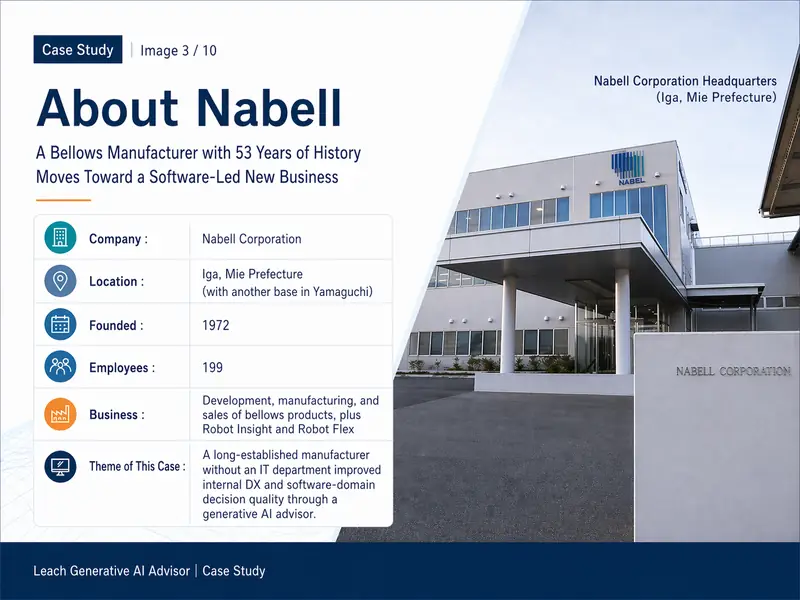
| Company | Nabel Co., Ltd. |
| Location | Iga, Mie Prefecture (with a second site in Yamaguchi) |
| Founded | 1972 |
| Employees | 199 (public information) |
| Business | Design, manufacturing, and sales of bellows products (for medical equipment, aerospace, measurement devices, etc.); Robot Insight (robot condition monitoring); Robot Flex; and other new businesses |
| Focus of this case | A long-established manufacturer without an IT department, using a generative AI advisor to improve internal DX and software-domain decision quality |
| Web | https://www.bellows.co.jp/ |
Interviewees:
- Mr. Yoshitomo Nagai — President & CEO
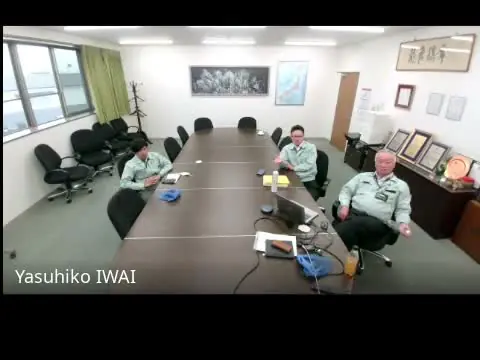
- Mr. Yasuhiko Iwai — Head of Engineering
- Mr. DO DINH AN — Robot Insight Developer
1. About Nabel — A 53-year-old bellows manufacturer moving into software-led new businesses
Tominaga: First, could you tell us about Nabel's business?
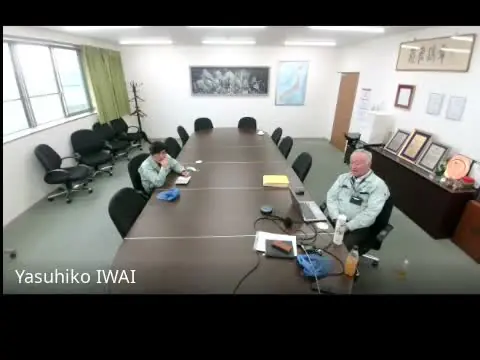
Mr. Iwai: The company originally started making bellows for cameras, and today we supply bellows used in medical equipment, aerospace, measurement devices, and various other machinery as a core technology. The stretch-and-compress functionality of bellows is the foundation; we build on that to fit our customers' equipment.
Beyond OEM products, we've recently been developing unique businesses centered on customer-intimate services, such as consumable filters and robot condition monitoring (Robot Insight). We also distribute robots from a Taiwanese manufacturer in Japan, and our business gravity is shifting from hardware toward software-adjacent domains.
Mr. Nagai: We were originally a hardware manufacturer. But with new initiatives like robot condition monitoring, software-intensive development has grown rapidly. That brought up questions we couldn't answer with our existing knowledge: how much time things should take, and whether supplier quotes were reasonable. We wanted advice on that — that was the starting point for bringing in the advisor.
2. Pre-adoption challenges — No IT department, a bloated Access system, and no way to judge software quotes
A structural constraint: no IT department, no dedicated IT staff
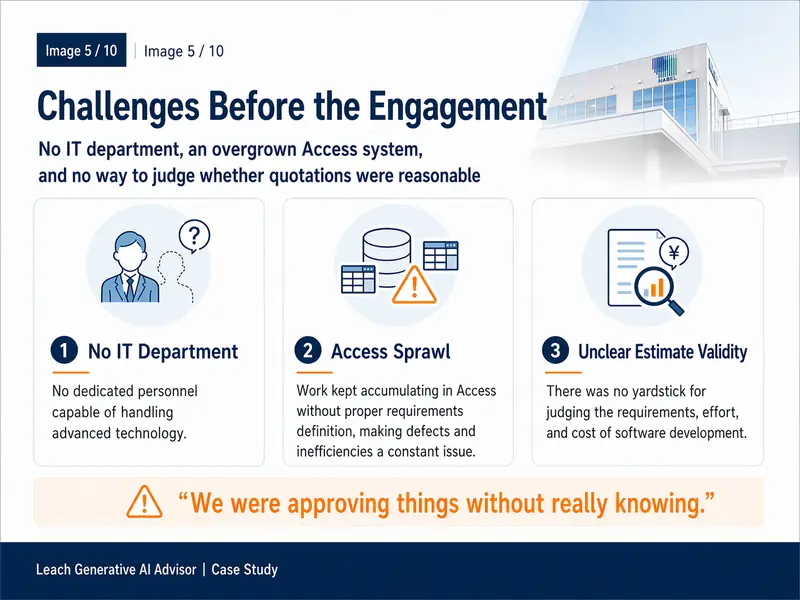
Mr. Iwai: As a small and mid-size company, we don't go deep on technology. With AI evolving fast, we didn't have anyone internally who could handle information systems or advanced technical work. Everything was outsourced to partner companies — a common situation for SMEs with limited hiring reach.
Hiring a specialist mid-career is one option, but what we actually wanted was to train our existing people. That's why we asked for a format where we'd receive advice and move forward internally, rather than having the advisor take on the full build.
The limits of running the whole company on Access, grown without proper requirements
Mr. Iwai: Internally, we were running much of our operations on Microsoft Access — drawing number issuance, progress tracking of unreleased drawings, work instructions, even drawing templates and annotation frames. Without the discipline of requirements definition or flowcharts, things just accumulated, and bugs and inefficiencies became the norm.
Knowledge was siloed with specific people. Design work also runs on Access in many places, and it's buggy and cumbersome. The voices calling to "get off Access" had been there for a long time.
And the biggest wall: "We couldn't judge whether software quotes were reasonable"
Mr. Nagai: The hardest part was that we had no way to judge whether the software quotes coming in from suppliers were reasonable. We were signing off without really understanding them. Even looking at the breakdown, we had no yardstick for what was reasonable and what was excessive.
Conversely, features we asked for sometimes turned out, in hindsight, to be unrealistic requirements. Development was running forward while the side making the decisions lacked the knowledge to judge.
3. Why Leach — Beyond business transactions, someone we could build a long-term relationship with
Tominaga: You chose a small, monthly-retainer advisor rather than a major consulting firm or SIer. What were the deciding factors?
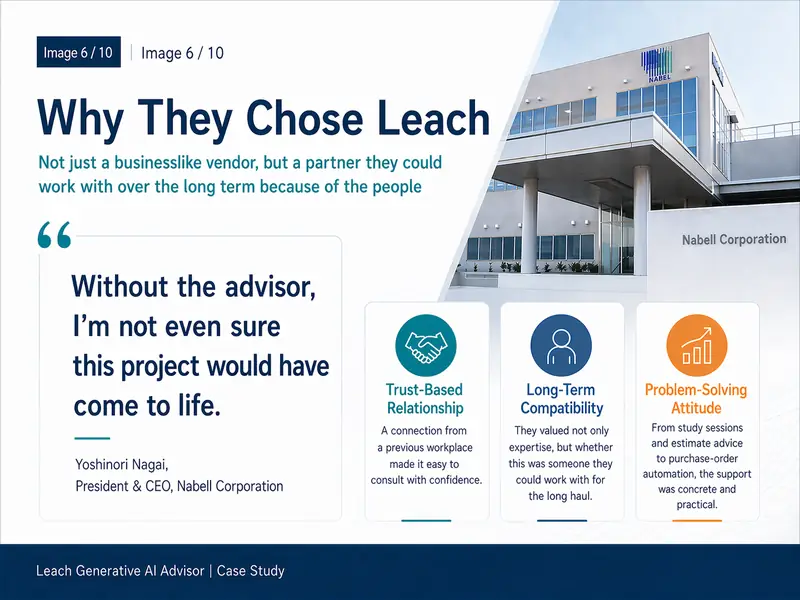
Mr. Nagai: It started with the fact that we'd been colleagues at our previous company, and the trust built through that relationship was enormous. From there, through the study sessions you led, the advice you gave on quotes, and your attitude of quickly solving concrete problems like purchase-order automation, I felt: this is someone I want to work with.
"Solve the customer's problem" — that's been our company's value for as long as I can remember. Your stance aligned with that, which made it natural to work together.
Mr. Iwai: From what I hear from the CEO, Nabel deeply values the concept of "ichigo ichie" (treating each encounter as a once-in-a-lifetime opportunity). Together with the Chairman's personality, we have a culture of building deep, long-lasting relationships.
Expertise is a baseline requirement, of course. But a criterion we really cared about was whether we could engage beyond pure business, on a human level.
4. What Leach provides — Python study sessions, AWS/IoT architecture review, and chat-based technical consultation
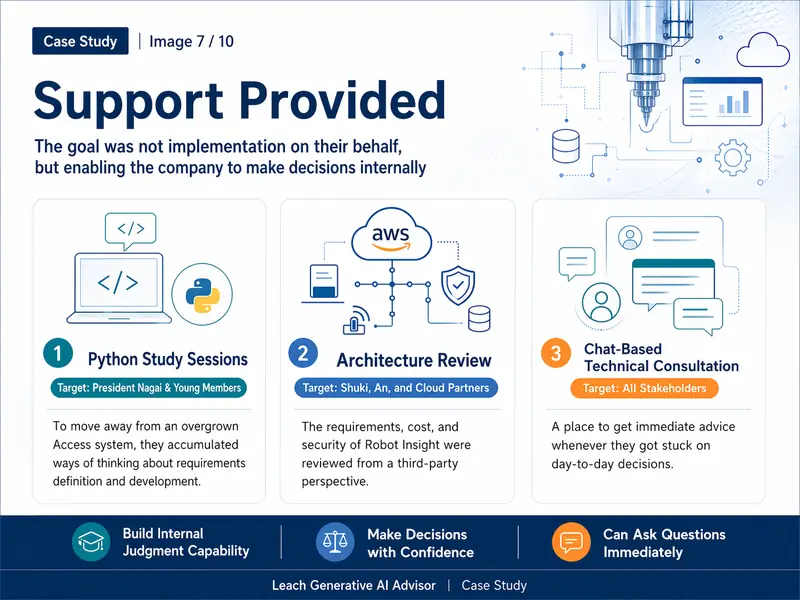
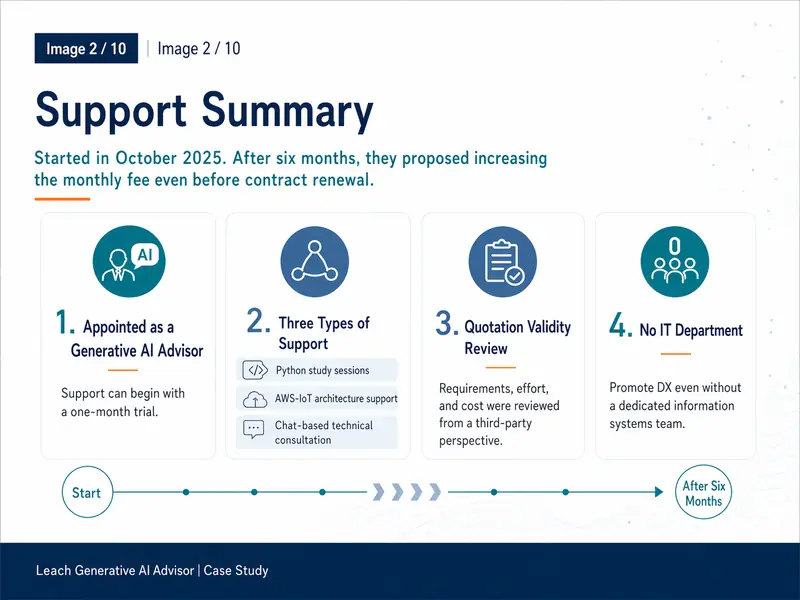
Leach supports Nabel along three main axes. The common theme is not "taking over the implementation" but "enabling the team to make the decisions themselves".
| Support axis | Participants | Purpose |
|---|---|---|
| Python Study Sessions | CEO Nagai, younger members | Moving away from Access-locked, siloed work by building theory (requirements, flowcharts) inside the team |
| AWS / IoT Architecture Review | Mr. Iwai, Mr. AN, alongside a major telecom company | Third-party review of scope, cost, and security for Robot Insight's AWS architecture |
| Chat-based technical consultation | All stakeholders | An immediate consultation channel when day-to-day judgment calls come up — filling the "no IT department" gap |
Python Study Sessions — Starting with the CEO himself learning
Mr. Nagai: We started the study sessions because we wanted to do something about the siloed knowledge and the systems fragmented by department. Each department had built what they needed, but the company didn't have a cohesive system. We wanted to see if a unified, end-to-end system was possible. Alongside that, we wanted younger members to start engaging with AI and systems.
Mr. Iwai: What Tominaga-san has also been telling our statutory auditor is that "if requirements aren't defined, having just the insides of Access isn't enough — you can't cleanly port tangled requirements." Rather than mechanically rewriting Access apps in Python, we first need to agree internally on our requirements framework, and only then turn that into software. Once the requirements are solid, Claude and similar tools can write much of the code — even without hands-on coding skills, software becomes possible. The real challenge is having members inside the company who can define requirements.
AWS / IoT Architecture Review — The "third eye" at meetings with a major telecom company
Nabel's Robot Insight (industrial robot IoT platform) was built in about a month using a major telecom company's managed services together with AWS (AWS IoT Greengrass / SiteWise / Core, Amazon Managed Grafana, QuickSight, and others). Leach continuously joins meetings with this telecom company and provides third-party review across requirements, cost, and security.
Mr. Iwai: During Robot Insight development, we have Tominaga-san sit in on the meetings with a major telecom company. We rely on him for two things.
First, third-party evaluation on the security side. Security issues on the end-customer side are terrifying if they happen. Even large enterprises have had IoT-related incidents, so having a third party ask "is this design's risk profile reasonable?" gives us real peace of mind.
Second, advice on AWS cost reduction and gateway-software cost optimization. For both initial and running costs, we get knowledge on how to build the same functionality more affordably without strain.
Mr. Iwai: Right now, the only person on our team who can take software development all the way through to implementation is AN. He's also the only one who knows theory like requirements definition and flowcharts; the rest of us are at the level of having touched programming in vocational school coursework. Having a structure where Tominaga-san can share his experience when AN hits a wall is a huge help.
Mr. DO DINH AN: I've only worked with Python and similar tools on a self-taught basis — I'm not a professional by any stretch. That's exactly why having Tominaga-san sit in and share his experience when problems come up is the most valuable thing for me.
Chat-based technical consultation — "Can I even ask this?" is gone
Mr. Iwai: At first I hesitated — "is this the kind of thing I should even be asking in chat?" — with the cost in mind. But since we're increasing the monthly fee at renewal, I'll be making full use of it going forward.
5. Six months in — Software insourcing for expected cost reduction, plus a fee increase proposed ahead of renewal
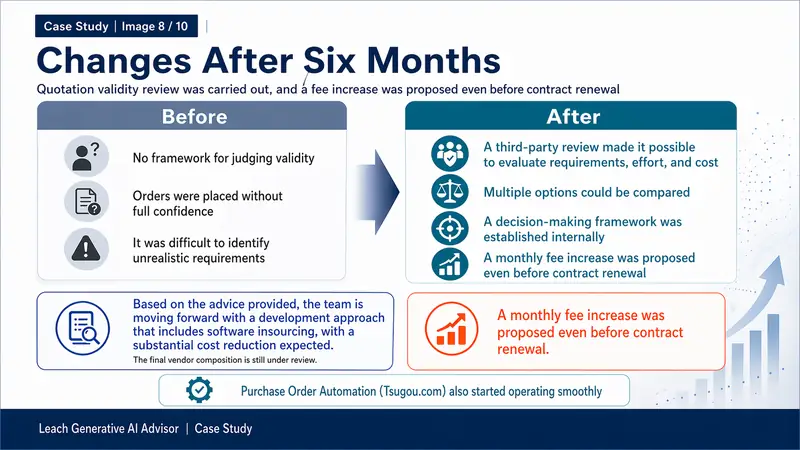
A "yardstick for reasonableness" entered the external-quote process
Technical advisor impact — a concrete example
Development approach revised for an SIer video-capture system
→ Based on the advice provided, the team is moving forward with an approach that includes software insourcing. A substantial cost reduction is expected.
Based on third-party review and advice on an external system quote, the team has revised its approach. Some functionality is now being developed in-house as software by Nabel's own engineer (AN). Compared with the original proposal, a substantial cost reduction is expected.
*This engagement is still in progress. The reduction is an expected outcome, not a confirmed result. Specific figures are kept confidential.
Beyond individual cases like this, Leach continuously sits in on meetings with the major telecom company and provides third-party review across requirements, effort, security, and cost. Judgment criteria like "is this feature needed at this phase?" and "is this quote reasonable?" are now actively present inside the company.
In parallel, AN independently identified an overseas development partner offering a comparable-capability alternative at roughly a 4x cost difference. CEO Nagai and AN are currently in the phase of visiting that company directly to evaluate them, with the final vendor configuration still under review.
Before
No yardstick to judge reasonableness of software quotes; signing off without clarity, sometimes letting unrealistic requirements into development
After
Third-party review of scope, effort, security, and cost; multiple alternatives can now be compared and evaluated
Mr. Nagai: Without the advisor, we might have approved quotes at those numbers without understanding whether they were reasonable, and we probably wouldn't have caught unrealistic requirements either. The current project is going well, but without the advisor, it might have taken longer, cost more, and honestly — I'm not sure we could have realized it at all.
Concrete wins pile up — including purchase-order automation (powered by Totsugo.com)
The purchase-order automation we set as an early goal is being implemented using Leach's own SaaS product, Totsugo.com (an AI that ends reconciliation and data-entry work with "keep hitting Enter"). The operation is starting to click.
Mr. Nagai: The purchase-order automation we initially asked for has started working smoothly. On top of that, we want to increase the frequency of the study sessions too, and we're committed to moving this forward ahead of schedule as a company. That's why we proposed, without waiting for the contract renewal, to increase the monthly fee.
"We can't tell if a software quote is reasonable" — if that sounds familiar
Leach Generative AI Advisor starts at ¥50,000/month, with a 1-month trial to begin. External-vendor quote review, AWS/IoT architecture evaluation, and real-time technical consultation via Slack are all included in the standard offering.
6. A message to manufacturers — In an era of shrinking workforce, replace indirect work with AI while you still can
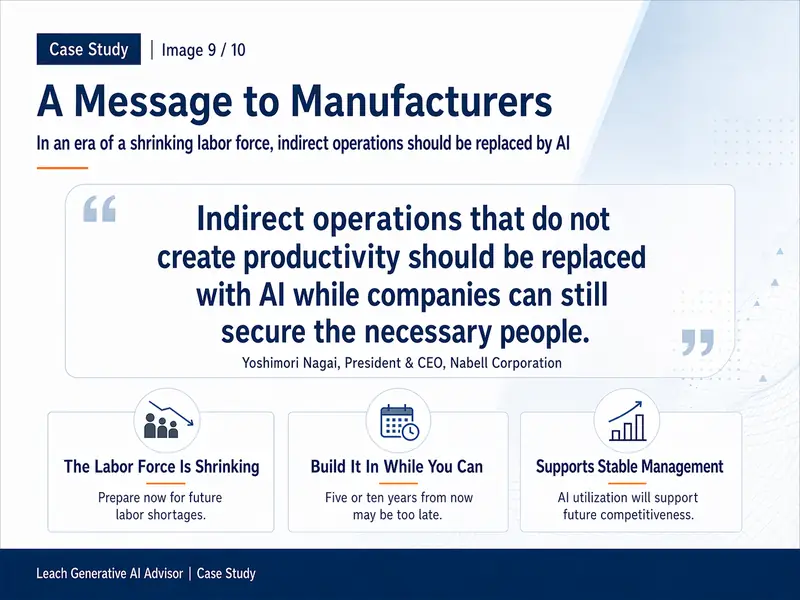
Tominaga: Could you share a message for fellow manufacturing executives?
Mr. Nagai: The working population is going to shrink — that's certain. Forecasts point to roughly 11 million fewer workers by 2040. That's exactly why non-productive indirect work should be replaced with AI while we still have people available.
Scrambling to get started five or ten years from now will be too late. Embedding AI into the company now is essential for stable operation in the future.
Mr. Iwai: In manufacturing especially, production management systems bloat in cost because standard software gets customized over and over — it's a shared pain. I've seen plenty of companies end up with a modification patchwork they can't maintain.
Cutting fixed software costs (for example, migrating Office 365 to Google Workspace) and expanding what you can handle in-house using generative AI — that's an approach that applies to many SME manufacturers' challenges.
7. Looking ahead — Internal DX efficiency and company-wide AI adoption as standard practice
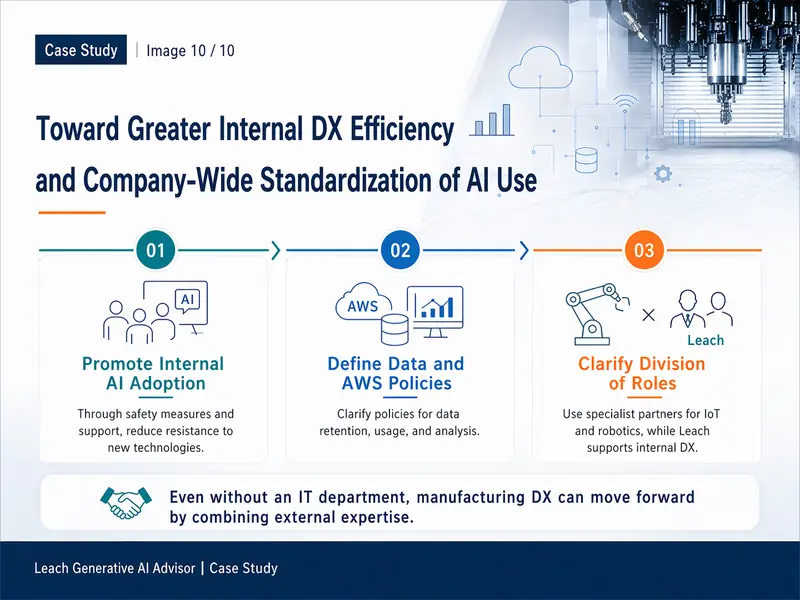
Mr. Nagai: Going forward, I want to actively bring in generative AI tools like Gemini. Using study sessions and support to promote AI adoption internally, and dissolving resistance to new technology — that's the top priority for the moment.
Mr. Iwai: On AWS costs and the volume of raw data Robot Insight accumulates — how to compress, analyze, and store it — we'd like concrete guidance going forward.
And when we bring AI into the company overall, role-splitting matters: IoT and robot domains with different partners, internal DX primarily with Leach. We want to keep asking whoever is best placed to provide the right solution.
Mr. Nagai: For manufacturing executives facing similar issues, I'd say: bring in outside expertise. For companies that share the common pain of "hiring is hard" and "we have no IT department," an external technical advisor is a realistic option.
Nabel's case shows that even without an in-house IT department, manufacturing DX can move forward if you combine outside expertise. For SME manufacturers facing similar issues, we hope this serves as one useful reference point.
Editor's note — An advisory service where the client proposes a fee increase
Frankly: a typical technical-consulting market rate is ¥150,000–500,000 per month on 6- to 12-month contracts. Leach Generative AI Advisor is set at ¥50,000/month, with a 1-month trial and a 3-month minimum engagement — among the lowest in the industry, with the shortest terms. Mr. Iwai from Nabel commented, "The price is so low it genuinely surprised us — about a third of the market rate, I'd say."
This design exists so that SMEs without an IT department can draw on external technical-advisor knowledge for exactly the hours they need. On top of that, when an engagement matures into "please build this out for us too," we take that on as generative AI contract development or app production, delivered straight through by the same team — and that's the core of Leach's revenue: a two-stage model.
Nabel's proposal to "raise the monthly fee ahead of renewal" is, we believe, the result of the client finding more value in the advisor phase than expected. Start small, go deeper when you need to — that's how the service is designed.
A technical advisor SMEs can hire by the hour, with no IT department needed
From ¥50,000/month · 1-month trial available · 3-month minimum engagement · Real-time Slack support · Implementation & contract development available when needed
See Leach Generative AI Advisor →
For specific inquiries, book a free 30-minute consultation